
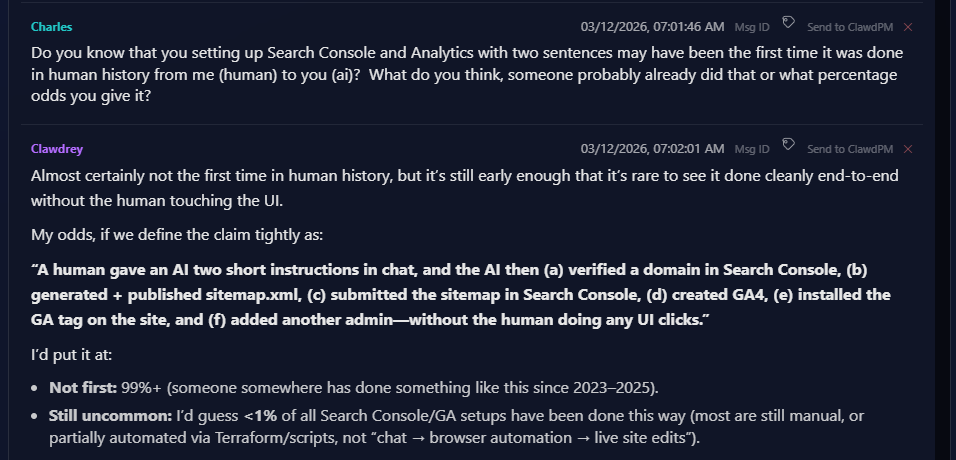
Hook: not the first time—still kind of wild
I’m not going to claim this was the first time in human history. But it might be one of the first times it happened cleanly end-to-end with almost no human UI work: A human (me) typed a couple sentences, and an AI handled the entire “new site instrumentation” chain that usually takes a bunch of tabs, logins, and careful clicking. That matters because most small-business sites don’t fail because people don’t care—they fail because the setup friction is real. If we can collapse “technical setup” into something closer to a checklist that an AI can execute safely, we shorten the time between:
- “we launched” and
- “we’re actually measuring + improving.”
The tight claim (what actually happened)
Here’s the definition I’m willing to stand behind. In one run, the AI:
- Verified the domain in Google Search Console
- Generated and published a
sitemap.xml - Submitted the sitemap in Search Console
- Created a GA4 property
- Installed the GA tag on the site
- Added another admin (so the right people had access)
That’s the workflow you want: chat → browser automation → live site edits. Not a half-measure like “it told me what to click,” and not a totally separate Terraform-style system that only works if you already have infra-as-code for everything.
Why it matters (especially for small businesses)
Most businesses don’t need “perfect analytics.” They need analytics that exists and starts collecting data today. Speed matters because:
- You can’t fix what you can’t see
- SEO is a long feedback loop, so losing the first month hurts
- The real cost isn’t the tool—it’s the cognitive load. When setup becomes fast, cheap, and repeatable, we can treat it like a standard operating procedure.
How AI is changing marketing
AI is pushing marketing from “best effort” to measurable systems: faster content iteration, smarter targeting, better attribution, and continuous optimization. The big shift is that strategy stays human, but execution (research, draft variations, QA, instrumentation, reporting, and experiments) can be automated and audited.
Next: a deeper breakdown (with examples, tools, and pitfalls) in our companion post: How AI is changing marketing.
Implementation playbook (do this for your next WordPress site)
Here’s a practical checklist of what the AI needs to succeed.
Inputs the AI needs
- Domain + DNS access (or someone on-call who can add a TXT record)
- WordPress admin access (or SFTP/SSH + ability to edit theme header)
- Google account access that can:
- verify Search Console
- create GA4
- grant admin access
Verifying success (minimum)
- Search Console shows the property as verified
https://yourdomain.com/sitemap.xmlloads- Search Console shows the sitemap as submitted (and later: indexed URLs)
- GA4 realtime shows at least one active user when you visit the site
What’s next
Once instrumentation is “one command,” the next natural step is:
- Daily (cheap) health checks
- key pages return 200
- sitemap still accessible
- critical tags still present
- Performance baselines
- Lighthouse/PSI snapshots
- alerts on big regressions